SubhanAllah, Alhamdulillah, and Allahu Akbar are three of the most frequently recited phrases in Islam, said individually, in sequence, and in a related but distinct combined form — "SubhanAllahi wa bihamdihi." This guide breaks down what each phrase means, how they're used together, and the authentic counts behind them.
What Do SubhanAllah, Alhamdulillah, and Allahu Akbar Mean?
SubhanAllah (سبحان الله) means "Glory be to Allah," affirming that Allah is free from any imperfection; Alhamdulillah (الحمد لله) means "All praise is due to Allah," acknowledging every blessing as coming from Him; and Allahu Akbar (الله أكبر) means "Allah is the Greatest," affirming His supremacy over everything else.
Each phrase is short by design — meant to be repeated easily, often in counted sets, so the meaning stays present in the mind rather than becoming a rushed habit. For the full list of dhikr phrases and how to use each one, see what to say when counting tasbih.
What Is the Difference Between "SubhanAllah Alhamdulillah" and "SubhanAllahi wa Bihamdihi"?
"SubhanAllah, Alhamdulillah" said as two separate phrases means "Glory be to Allah, [and] praise be to Allah," typically counted separately (33 times each); "SubhanAllahi wa bihamdihi" is a single combined phrase meaning "Glory be to Allah and praise be to Him," narrated in Sahih al-Bukhari (Hadith 6406) as light on the tongue but heavy on the scale of good deeds.
These are two distinct, both-authentic forms of dhikr rather than the same phrase written differently — the post-salah 33-33-34 count uses the separate phrases, while "SubhanAllahi wa bihamdihi" is commonly recited independently, often 100 times, as its own dhikr.
Where Does the 33-33-34 Count Come From?
The 33-33-34 count — SubhanAllah 33 times, Alhamdulillah 33 times, Allahu Akbar 34 times, totaling 100 — comes from Sahih Muslim (Hadith 596), where the Prophet ﷺ taught this specific sequence to be recited after each of the five daily prayers.
For the full context of when and how to recite this count, see our guide on dhikr after prayer. Some narrations describe completing the hundred with a closing phrase of tawhid rather than adding an extra Allahu Akbar — both versions are widely practiced.
What Is "SubhanAllahi wa Bihamdihi, SubhanAllahil Azeem"?
"SubhanAllahi wa bihamdihi, SubhanAllahil azeem" means "Glory be to Allah and praise be to Him, glory be to Allah the Magnificent" — a longer combined phrase narrated in Sahih al-Bukhari as beloved to Allah and light to say, often recited 100 times as its own dedicated dhikr session.
This phrase is distinct from the shorter "SubhanAllahi wa bihamdihi" — the addition of "SubhanAllahil azeem" makes it a two-part statement, and both halves are usually recited together rather than separately.
How Do You Keep Track of These Phrases Without Mixing Them Up?
The easiest way to avoid mixing up SubhanAllah, Alhamdulillah, Allahu Akbar, and their combined forms is to dedicate a separate counting session to each phrase — finishing one phrase's full count before switching to the next, rather than alternating mid-count.
- One phrase at a time: Complete all 33 (or 100) of one phrase before moving to the next, rather than switching every few repetitions.
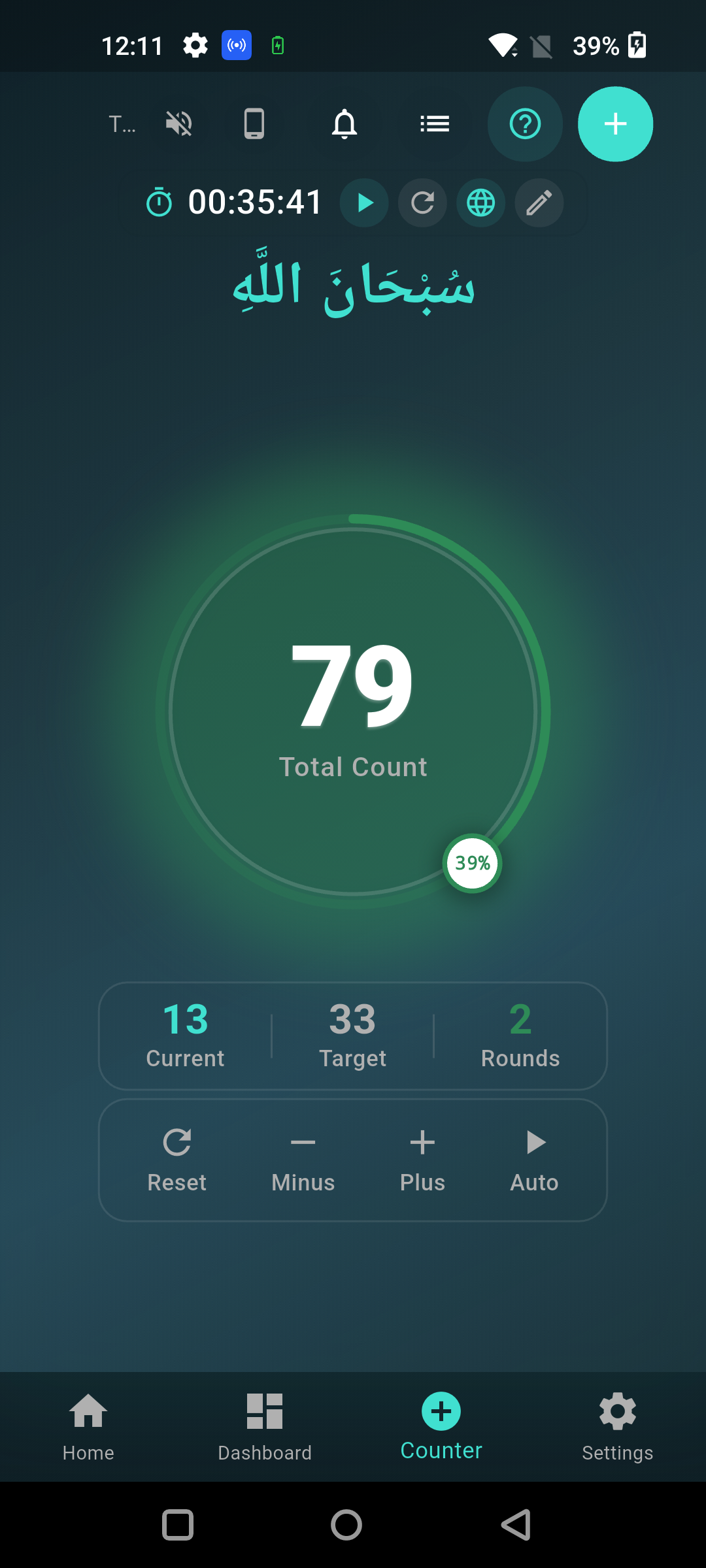
- Use presets if you're using an app: A digital counter that lets you save named presets (SubhanAllah, Alhamdulillah, Allahu Akbar, SubhanAllahi wa bihamdihi) removes the guesswork of "which phrase was I on."
- Beads work the same way: Complete one full pass of the tasbih for one phrase before resetting for the next — see our misbaha prayer beads guide for more on this.
FAQ
Is "SubhanAllah wa bihamdihi" the same as saying SubhanAllah and Alhamdulillah separately? No — "SubhanAllahi wa bihamdihi" is one combined phrase narrated on its own, distinct from reciting SubhanAllah and Alhamdulillah as two separate 33-count phrases; both are authentic but are different forms of dhikr.
How many times should I say SubhanAllahi wa bihamdihi? There's no single fixed requirement, but it's commonly recited 100 times as a dedicated dhikr session, separate from the post-salah 33-33-34 count.
What does "SubhanAllahil Azeem" mean on its own? "SubhanAllahil Azeem" means "Glory be to Allah, the Magnificent" — it's usually recited as the second half of the longer phrase "SubhanAllahi wa bihamdihi, SubhanAllahil azeem," rather than said completely on its own.
Can I recite these phrases in English instead of Arabic? Yes, you can say the English translations ("Glory be to Allah," "All praise is due to Allah") as valid remembrance, though the Arabic wording is what's specifically narrated in the hadith and is the form most Muslims memorize and recite.
Is it better to say SubhanAllah, Alhamdulillah, and Allahu Akbar together or separately? Both are valid — the post-salah tradition counts them separately (33-33-34), while phrases like "SubhanAllahi wa bihamdihi" combine glorification and praise into a single recitation; which one you use often depends on the specific dhikr occasion.
Count Every Phrase Accurately
Whether you're reciting the 33-33-34 post-salah tasbih or a dedicated 100-count of SubhanAllahi wa bihamdihi, download the free Tasbeeh Counter app to keep each phrase's count accurate with saved presets, offline and private.