A dhikr counter is one of the simplest tools in a Muslim's daily worship, yet most people never think carefully about which type to use or why it matters. Whether you spell it dhikr counter or zikr counter, the tool serves the same purpose — helping you count your remembrance of Allah accurately, without losing track mid-recitation. This guide covers what a dhikr counter is, the different types available, and how to actually use one, whether that's a string of beads passed down from your grandmother or an app on your phone.
What Is a Dhikr Counter?
A dhikr counter is any tool used to count repetitions of dhikr (remembrance of Allah) — traditionally a string of prayer beads called tasbih or misbaha, but today more commonly a mechanical clicker, a ring counter, or a digital counter app. Its only job is to track how many times you've repeated a phrase like SubhanAllah or Alhamdulillah so you can focus on the words instead of counting in your head.
Muslims have used physical counting tools for dhikr for over a thousand years, and the underlying need hasn't changed — only the form factor has. A tasbih of 33 or 99 beads does the same job as a phone app with a "+1" button: it frees your mind from arithmetic so it can stay on the meaning of what you're saying. The word "dhikr" (ذكر) means remembrance, and the counter is simply the accessory that supports it.
What Is the Difference Between "Dhikr Counter" and "Zikr Counter"?
There is no difference — "dhikr counter" and "zikr counter" describe the exact same tool; "zikr" is simply a common alternate transliteration of the Arabic word ذكر (remembrance), used more often in South Asian English (India, Pakistan, Bangladesh) while "dhikr" is more common in Arabic-influenced and academic English.
Both spellings are correct because Arabic doesn't map perfectly onto the Latin alphabet — you'll also see "zikar" or "zikir" occasionally. The same variation happens with tasbeeh/tasbih, where both spellings refer to the same practice of glorifying Allah through repeated phrases. When you're searching for an app or article, it's worth trying both spellings, since search engines and app stores don't always treat them as identical. This app and most guides on this site use both spellings interchangeably so nothing gets missed.
Why Do Muslims Use a Dhikr Counter?
Muslims use a dhikr counter mainly to fulfil specific counted acts of worship accurately — like the 33-33-34 tasbih after each of the five daily prayers — without breaking concentration to keep a mental tally. Allah commands frequent remembrance directly in the Quran: "O you who believe! Remember Allah with much remembrance" (Quran 33:41). A counter makes that remembrance sustainable as a daily habit rather than a one-off effort.
There's also a narrated virtue tied to specific counts. In Sahih Muslim (Hadith 596), the Prophet ﷺ taught his companions to say SubhanAllah 33 times, Alhamdulillah 33 times, and Allahu Akbar 34 times after each prayer. Getting to exactly 33 or 34 reliably, five times a day, every day, is genuinely hard to do from memory — which is exactly the gap a counter closes. For a deeper look at the spiritual rewards tied to this practice, see our full guide on the benefits of tasbeeh counting.
What Types of Dhikr Counters Are There?
There are four main types of dhikr counters in common use today: manual prayer beads (tasbih/misbaha), finger counting, mechanical clicker or ring counters, and digital counter apps — each suited to a different situation.
- Manual beads (tasbih/misbaha): A string of 33, 99, or 100 beads, moved one at a time with the thumb. Tactile, needs no battery, and is the traditional choice — see our misbaha prayer beads guide for how to choose one.
- Finger counting: Using the knuckles and joints of the right hand to count without any tool at all — the method many scholars note the Prophet ﷺ himself used. Covered in detail in how to count tasbeeh on fingers.
- Mechanical clicker / ring counter: A small handheld clicker or a wearable ring with a button, popular for counting large numbers (100s or 1000s) without needing to reset beads.
- Digital counter app: A phone app with a tap-to-count button, often with saved presets, daily goals, and history — the most practical option when you're already carrying your phone everywhere.
How Do You Use a Digital Dhikr Counter App?
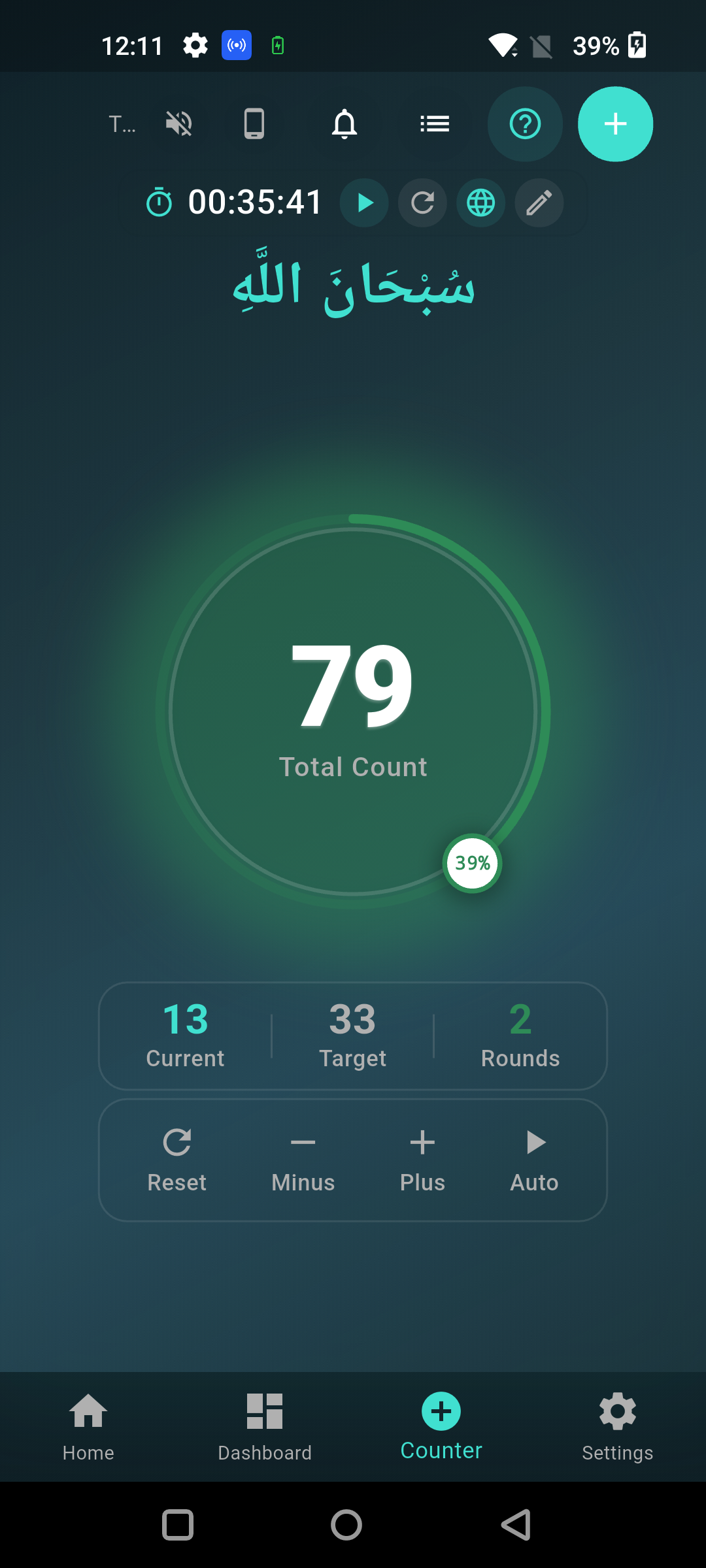
To use a digital dhikr counter app, open the app, select or type the dhikr phrase you're reciting, then tap the counter button once for every repetition — the app keeps the running total on screen so you never lose count, even if you're interrupted.
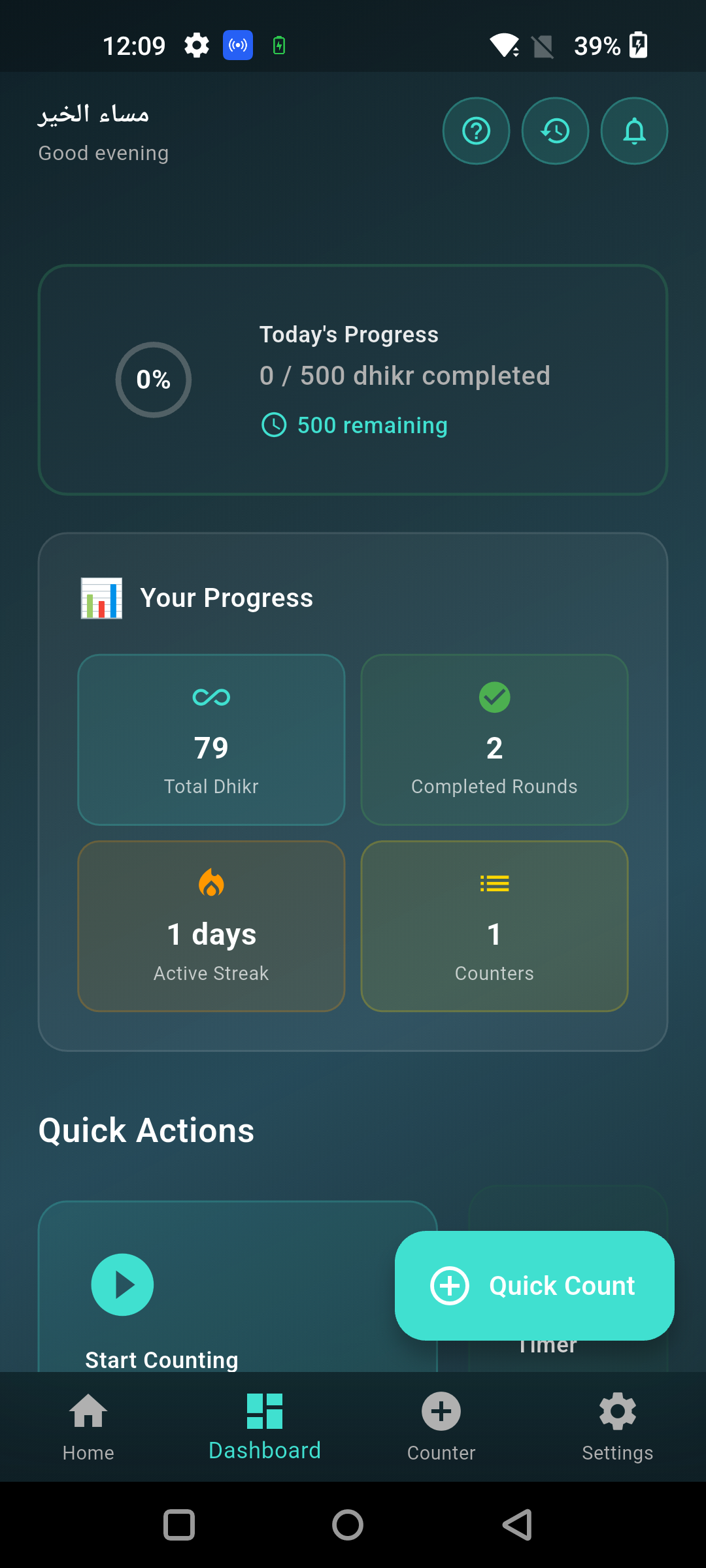
Most apps, including Tasbeeh Counter, add a few things beads can't do on their own: a target count (so it stops or alerts you at 33, 99, or 100), a history of past sessions, and the ability to save multiple dhikr presets so you don't have to reset between SubhanAllah and Alhamdulillah. Some apps also support counting via volume buttons, which is handy if you want to keep your phone in your pocket while walking. For a full walkthrough of setup and features, read how to use Tasbeeh Counter.
Which Dhikr Counter Is Best — App, Ring, or Beads?
The best dhikr counter depends on your situation: beads are best for focused, phone-free worship; a ring or clicker is best if your hands are busy elsewhere; and an app is best if you want history, goals, and reminders alongside your daily count.
| Type | Best for | Downside |
|---|---|---|
| Beads (tasbih/misbaha) | Distraction-free, traditional feel | No history or reminders |
| Finger counting | No tool needed, always available | Easy to lose count past 99 |
| Ring/clicker | Hands busy (commuting, walking) | Can't track long-term progress |
| App | Goals, history, reminders, multiple dhikr | Needs a charged phone |
Many people use more than one — beads at home during dedicated worship, and an app for tracking daily totals and building a streak. There's no rule against switching between them; the goal is consistent remembrance, not the tool itself. Our comparison of digital vs physical tasbeeh counters goes deeper into this trade-off.
What Dhikr Phrases Should You Count?
The five most commonly counted dhikr phrases are SubhanAllah (Glory be to Allah), Alhamdulillah (All praise is due to Allah), Allahu Akbar (Allah is the Greatest), La ilaha illallah (There is no god but Allah), and Astaghfirullah (I seek forgiveness from Allah) — each carries its own meaning and is often counted separately in sets of 33, 99, or 100.
These phrases appear throughout the Quran and hadith as recommended remembrance, and Sahih al-Bukhari (Hadith 6406) records the Prophet ﷺ saying that two phrases — "SubhanAllahi wa bihamdihi, SubhanAllahil Azeem" — are light on the tongue but heavy on the scale of good deeds. For the full list of phrases and their proper pronunciation and meaning, see what to say when counting tasbih.
FAQ
Is dhikr counter and tasbeeh counter the same thing? Yes. "Dhikr counter" describes the function (counting remembrance), while "tasbeeh counter" or "tasbih counter" often refers specifically to the physical or digital tool used to do it. In everyday use, people treat the terms as interchangeable.
Can I use a phone app instead of prayer beads? Yes, a phone app is a valid substitute for prayer beads. What matters in dhikr is the sincerity and accuracy of the remembrance, not the tool used to count it. Many scholars affirm that any counting method — beads, fingers, or an app — is permissible.
How many times should I recite dhikr per day? There's no single fixed number for all dhikr, but the well-known post-prayer tasbih (33 SubhanAllah, 33 Alhamdulillah, 34 Allahu Akbar) totals 100 repetitions after each of the five daily prayers, per Sahih Muslim 596. Many people set additional personal daily goals on top of this.
Does a dhikr counter app work offline? Most well-designed dhikr counter apps, including Tasbeeh Counter, work fully offline since counting doesn't require an internet connection. Check the specific app's listing to confirm offline support before relying on it during travel.
What's the difference between a zikr counter ring and a regular tasbih? A zikr counter ring is a wearable device with a small mechanical or digital counter built in, worn on the finger so you can count while your hands are otherwise occupied. A regular tasbih is a string of beads you hold and move manually, requiring a free hand.
Is it better to count dhikr with the right hand? Many scholars note it is preferred to use the right hand or fingers of the right hand for counting dhikr, following the general practice of using the right hand for virtuous acts. This applies most directly to finger counting; using an app or beads in either hand is still valid.
Start Counting Your Dhikr Today
Whether you prefer beads, your fingers, or a digital counter, what matters most is consistency. If you'd like a simple, ad-light way to track your daily dhikr with presets, goals, and history, download the free Tasbeeh Counter app — it supports every dhikr phrase, works offline, and keeps your remembrance private and on your own device.