A tasbih counter helps you keep an accurate total while repeating words of remembrance. It may be your fingers, a string of prayer beads, a small electronic device, a website, or an app. The tool records the number; your tongue and heart perform the dhikr.
This guide explains which authentic adhkar include set numbers, how to use physical and digital methods, and how to protect your focus. In South Asia, tasbeeh and zikr are also common spellings.
Quick guide
- Confirm the dhikr's wording and count from a sound source.
- Count with attention, using fingers, beads, or a digital tool.
- Treat the total as an aid, not a score.
What is a tasbih counter?
A tasbih counter is any simple aid used to track repeated dhikr without relying on memory alone. It can be a hand, a misbaha with 33 or 99 beads, a clicker worn on a finger, or an app with a tap button. “Tasbih” can mean saying SubhanAllah—declaring Allah free from imperfection—and is also used more broadly for repeated remembrance. “Counter” describes the tool, not a separate religious practice. A useful counter should be easy to operate, easy to reset, and quiet enough not to disturb prayer or reflection. Digital versions may save totals, mark targets, or give gentle vibration feedback. Physical beads offer a tactile rhythm and need no battery. Neither format makes a dhikr more sincere or more accepted. The best choice is the one that helps you preserve the correct wording, number, presence of heart, and regularity without turning remembrance into a race.
If you want the mechanics in more detail, read what a digital tasbih counter is. A counter is useful during personal remembrance, after salah, on a commute, or while waiting, provided the time and place are suitable.
Why do Muslims count tasbih?
Muslims count tasbih because some forms of dhikr were taught with specific numbers, and counting helps complete them accurately. Allah commands believers to remember Him often and glorify Him morning and evening in Qur'an 33:41–42. He also says that hearts find comfort in His remembrance in Qur'an 13:28. The number is therefore a guide within an act of worship, not the purpose by itself. For example, an authentic narration prescribes saying SubhanAllah, Alhamdulillah, and Allahu Akbar 33 times each after prayer, followed by a statement of Allah's oneness to complete 100 (Sahih Muslim 597a). Keeping count helps a worshipper follow that teaching without guessing. At the same time, many general adhkar have no fixed total. Muslims should not invent a special number, promise a reward Allah and His Messenger did not promise, or assume a larger total automatically means better remembrance.
Counting can also make a daily practice manageable. A goal of 33 is clear and repeatable. Still, accuracy and attention belong together: a correct total said carelessly should not be the aim.
How do you use a tasbih counter step by step?
Choose a sourced dhikr, set its target, then make one deliberate count only after saying the complete phrase. First, decide what you will recite and check whether it has a prescribed number. Reset the tasbih counter to zero before you begin. Hold beads or a device comfortably, so hand movement does not demand your attention. Say the phrase clearly at a natural pace, understand its meaning, and advance the counter once. Continue until the displayed total or bead position reaches the target. If you are interrupted and cannot remember whether you counted the last phrase, use the lower certain number rather than adding a doubtful count. At the end, recite any completion taught in the relevant narration; do not treat an app alert as part of the worship. Review the total, reset when ready, and avoid tapping extra times simply to preserve a streak or personal record.
Here is a practical routine:
- Select: Choose one dhikr and its verified count.
- Prepare: Set or reset the counter away from distractions.
- Recite: Say the whole phrase with attention to its meaning.
- Count: Move one bead or register one tap.
- Complete: Stop at the target and say any prescribed closing words.
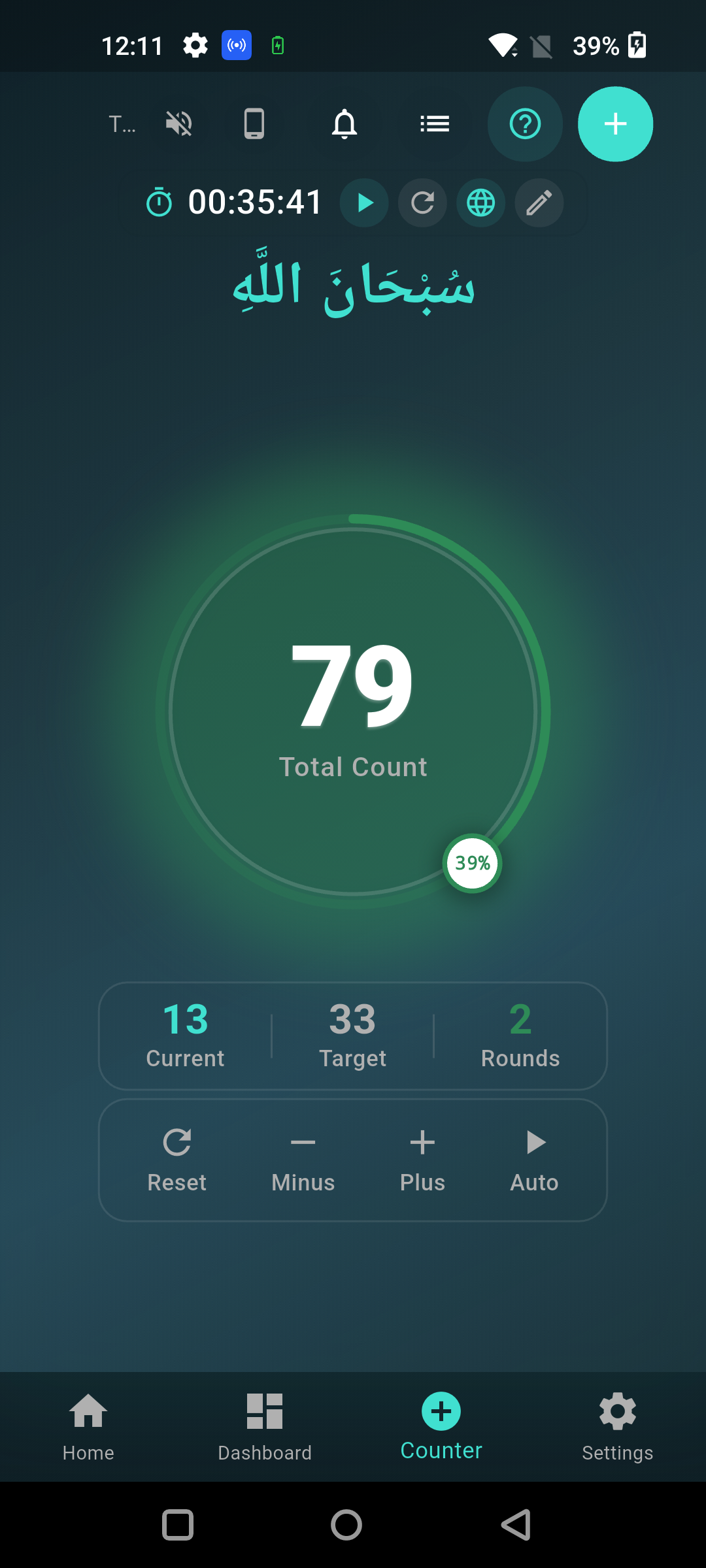
For a fuller walkthrough, see how to use a tasbeeh counter.
Which dhikr can you count with it?
You can count any lawful remembrance, but use fixed totals only when they come from reliable Islamic evidence or when the number is merely a personal organisational goal. A well-known post-prayer form is 33 repetitions each of SubhanAllah (Glory be to Allah), Alhamdulillah (all praise is for Allah), and Allahu Akbar (Allah is greater). Sahih Muslim 597a then completes 100 with La ilaha illAllahu wahdahu la sharika lah, lahul-mulku wa lahul-hamdu wa Huwa 'ala kulli shay'in Qadir. Before sleep, the Prophet Muhammad ﷺ taught Fatimah and Ali (may Allah be pleased with them) to say SubhanAllah 33 times, Alhamdulillah 33 times, and Allahu Akbar 34 times (Sahih al-Bukhari 5362; Sahih Muslim 2727). These are separate occasions and should not be casually merged. General istighfar, salawat, and other established adhkar may also be tracked according to sound guidance.
| Occasion | Words | Count | Source |
|---|---|---|---|
| After obligatory prayer | SubhanAllah, Alhamdulillah, Allahu Akbar | 33 each, then tahlil to 100 | Sahih Muslim 597a |
| Before sleep | SubhanAllah, Alhamdulillah, Allahu Akbar | 33, 33, 34 | Sahih al-Bukhari 5362; Sahih Muslim 2727 |
Learn the phrases before chasing totals. Our guide to what to say when counting tasbih explains common wording and meaning.
Should you choose fingers, beads, or a tasbih digital counter?
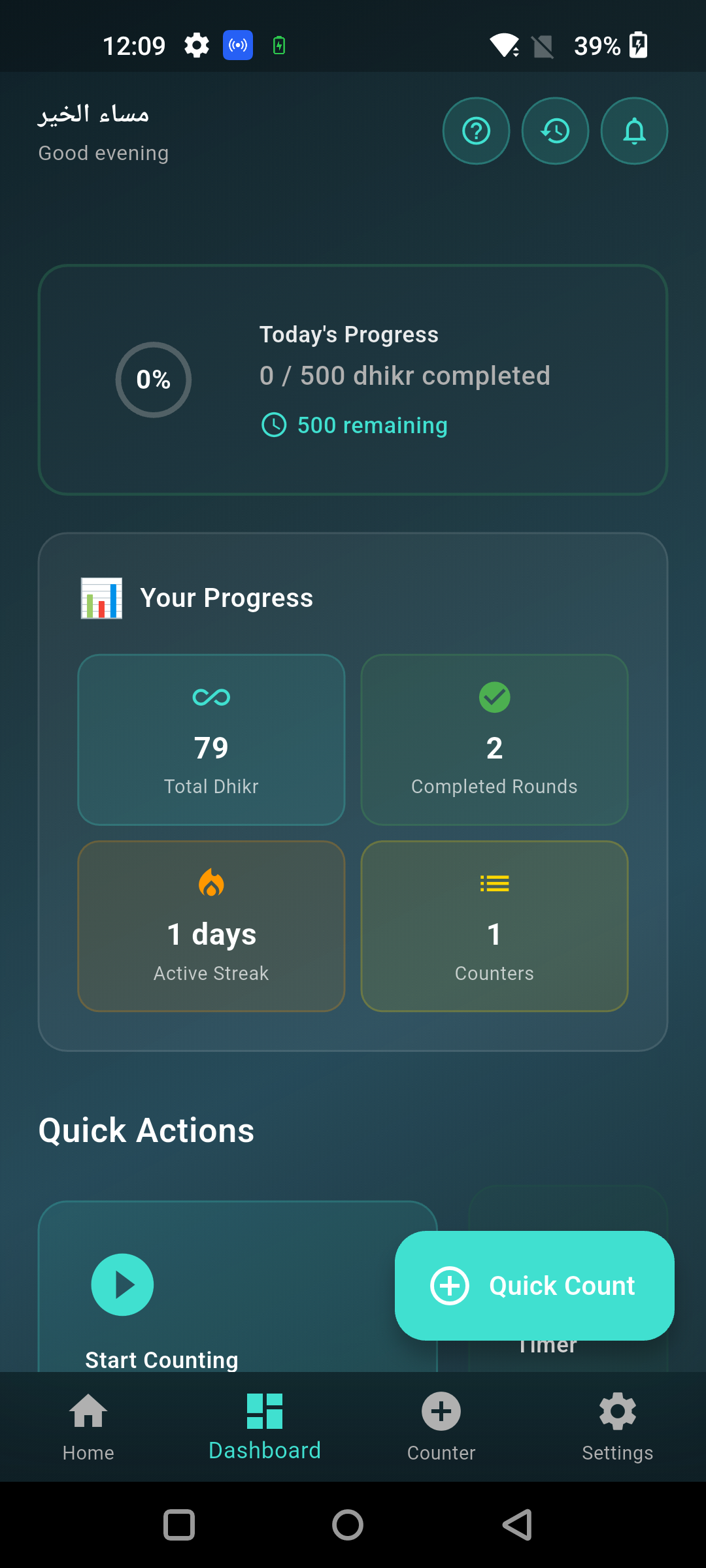
Choose fingers for a method always available, beads for tactile tracking, or a tasbih digital counter for saved totals and portability. Finger counting needs no object and keeps the practice discreet, though a beginner may lose their place. A misbaha or subha makes progress easy to feel and can work without power, but it is another item to carry. A ring clicker is compact, yet its button and display may draw attention. An app can store several dhikr names, targets, and unfinished counts; notifications and excessive statistics can also distract if poorly configured. There is no universal winner for every person or setting. Begin with the method that lets you recite correctly and calmly. If you use a phone, silence unrelated alerts and avoid opening other apps. If you use beads, choose a strong, plain strand that moves comfortably. The worship is remembrance of Allah; the counter remains a practical means.
| Method | Main advantage | Watch for |
|---|---|---|
| Fingers | Always with you | Losing your place |
| 33/99 beads | Clear tactile rhythm | Carrying or breaking the strand |
| Ring counter | Small and fast | Clicking without reflection |
| App | Targets, labels, saved progress | Phone distractions |
Read how to count tasbeeh on fingers or explore the misbaha and prayer beads guide for those two methods.
How can you count without losing focus?
Slow the recitation, understand each phrase, and let the counter handle only the total. Start with one short set in a quiet moment rather than several ambitious targets. Place the device on silent mode, disable unnecessary alerts, and keep the screen simple. If using beads, move one bead only after the phrase is complete. Reflect briefly on the meaning: SubhanAllah declares Allah's perfection, Alhamdulillah directs praise to Him, and Allahu Akbar reminds you that Allah is greater. Do not compete publicly over totals or judge another person's worship by a displayed number. Missing a self-chosen streak is not a reason to rush or despair. If tiredness makes the words automatic, pause and return with attention. A small regular practice can be easier to sustain than a large plan that soon stops. The counter should reduce mental load so that the heart can attend to remembrance, not replace that attention.
A simple focus check is to ask after each set: Did I pronounce the words properly? Did I remember their meaning? Did the tool help, or did it become the centre of the activity?
Frequently Asked Questions
Is a tasbih counter the same as a tasbeeh counter?
Yes. Tasbih counter and tasbeeh counter are English transliterations of the same Arabic term. Search habits differ by country and community. You may also see dhikr counter or zikr counter. The spelling changes, but all describe a tool for tracking repeated remembrance.
Is 33 or 99 the correct tasbih count?
Both numbers can be relevant. Sahih Muslim 597a teaches three phrases 33 times each after prayer, making 99, followed by tahlil to complete 100. Another authentic bedtime practice uses 33, 33, and 34. Follow the count for the specific narration and occasion.
Can I use a phone while counting tasbih?
Yes, a phone app can serve as a counting aid. Set it up before beginning, silence messages, and register one tap per complete phrase. The phone and saved total have no special religious status; they simply help you keep your place.
What should I do if I lose count?
Return to the lower number you are certain you completed. This avoids claiming a doubtful repetition. If the dhikr has no prescribed count, you may simply continue without anxiety. A counter's saved progress can reduce this problem when interruptions are common.
Does a higher counter total mean greater reward?
Not automatically. Rewards are established by Allah and His Messenger, and deeds also involve intention and correct practice. Do not attach invented promises to a number. Follow authentic guidance, remain sincere, and use the total as an aid rather than a measure of spiritual rank.
Make counting support your remembrance
A good tasbih counter makes counting quieter and easier, then gets out of the way. Choose an authentic dhikr, learn its meaning, use the right count for its occasion, and favour steady attention over impressive totals.
Ready for a distraction-free digital option? Download the free Tasbeeh Counter app and begin a simple dhikr routine today.
Sources: Qur'an 33:41–42, Qur'an 13:28, Sahih Muslim 597a, Sahih al-Bukhari 5362, and Sahih Muslim 2727.