App stores are full of Islamic apps of wildly different quality — some genuinely useful, others ad-heavy or abandoned after one update. This guide covers the categories of Islamic apps worth having on your phone in 2026, and what to actually look for in each one.
What Categories of Islamic Apps Do Muslims Actually Use Daily?
The Islamic apps Muslims use most consistently fall into five categories: prayer time and qibla apps, Quran reading and recitation apps, dhikr and tasbeeh counters, dua and adhkar reference apps, and Ramadan-specific tools like fasting trackers — most people end up with two or three of these rather than one app that tries to do everything.
Apps that try to combine all five categories into one bloated "super app" often do each function worse than a focused app built for just one job. It's usually better to pick one solid app per category.
What Should You Look for in a Prayer Time App?
A good prayer time app should calculate accurate times based on your exact location and a recognized calculation method (ISNA, Muslim World League, Umm al-Qura, etc.), send reliable notifications, and include a qibla compass — without requiring constant internet access just to show today's times.
Prayer time apps are one of the most searched Islamic app categories, and the difference between a good and bad one usually comes down to calculation method accuracy and whether notifications actually fire on time in the background — test this for a few days before trusting it fully.
What Makes a Good Dhikr or Tasbeeh Counter App?
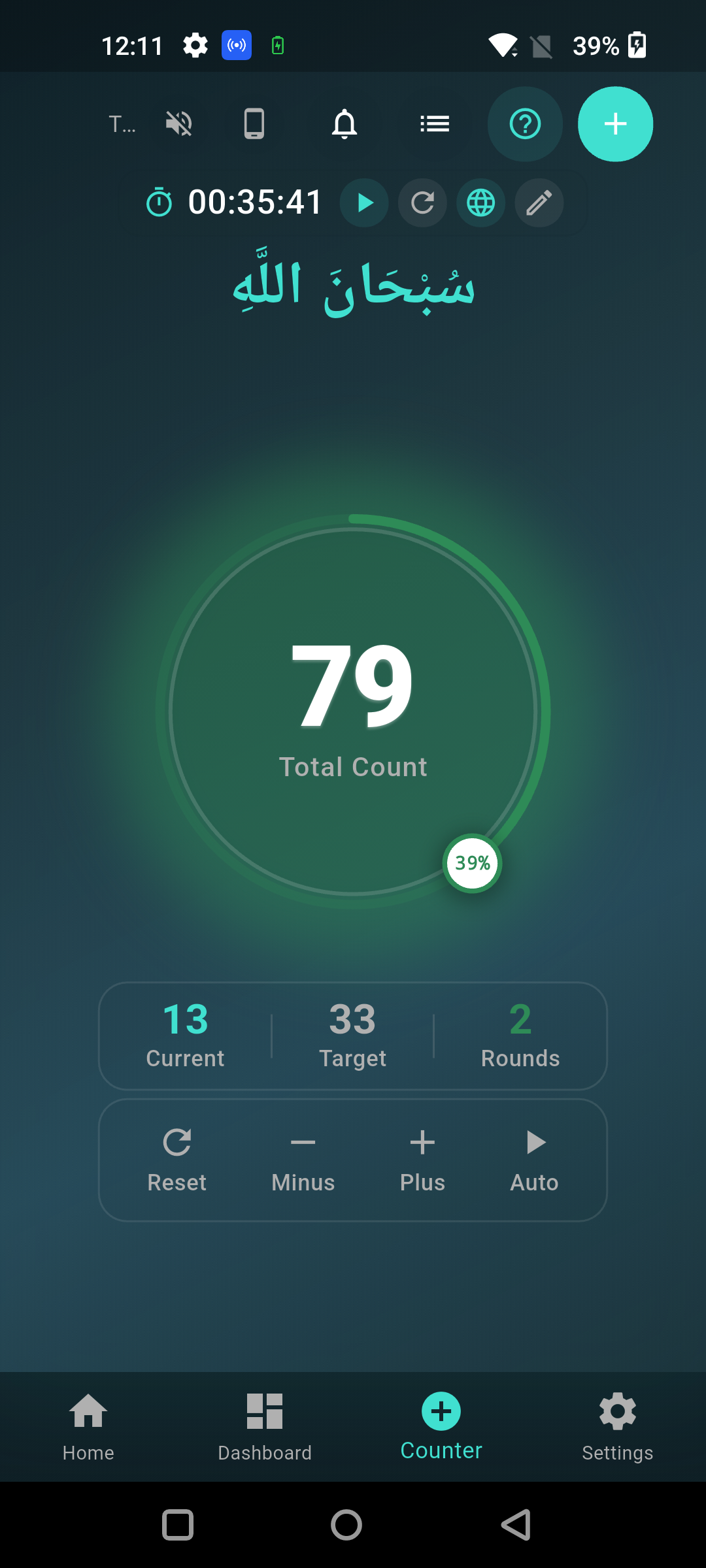
A good dhikr counter app should let you save multiple named presets (SubhanAllah, Alhamdulillah, dhikr after prayer, etc.), track daily and lifetime totals, work fully offline, and avoid intrusive ads that interrupt your counting mid-session.
- Offline-first: Dhikr counting shouldn't require an internet connection — see why use a private dhikr app for why this matters beyond convenience.
- Multiple presets: Switching between SubhanAllah, Alhamdulillah, and custom dhikr without losing your place.
- Session history: Seeing your past counts helps build consistency — related to building a daily dhikr streak.
- No account required: The best privacy-respecting apps let you start counting immediately, without signup.
What Should You Look for in a Quran App?
A good Quran app should offer clear Arabic text with a legible mushaf-style layout, accurate translations in your language, word-by-word transliteration if you're still learning to read Arabic, and audio recitation from reputable qaris — bonus points for offline downloads of both text and audio.
Quran reading and recitation is one of the highest-demand Islamic app categories, and quality varies enormously — check that the translation is from a recognized source and that the app doesn't bury the actual reading experience under ads or paywalls.
Are Free Islamic Apps as Good as Paid Ones?
Many of the best Islamic apps are genuinely free, especially for core functions like prayer times, Quran reading, and dhikr counting — paid tiers usually unlock extras like ad removal, custom themes, or advanced statistics rather than gating essential features.
Before paying for a "premium" Islamic app, check whether the free version already covers what you actually need. A simple, ad-light, offline-capable free app often beats a bloated paid one with features you'll never use.
FAQ
What's the single most useful Islamic app to start with? A prayer time app is usually the most immediately useful, since it's something you'll check multiple times a day — pair it with a dhikr counter for post-prayer remembrance.
Are Islamic apps safe for privacy, or do they sell your data? It varies significantly by app — check the privacy policy and app store data-safety label before installing, and prefer apps that work offline and don't require an account, since these typically collect far less data.
Do I need separate apps for prayer times, Quran, and dhikr, or is one app enough? Separate, focused apps for each category usually work better than one all-in-one app, since combined apps tend to do each individual function less well than a dedicated tool.
How do I know if an Islamic app's Quran translation is reliable? Check that the app credits a named, recognized translator (such as Saheeh International, Yusuf Ali, or Muhsin Khan) rather than an unattributed or machine-generated translation.
Is it okay to use an Islamic app instead of physical prayer beads or a printed Quran? Yes — using an app is a valid substitute for physical tools; what matters most is consistency and sincerity in worship, not the medium. Many people use both together, depending on the situation.
Start With a Focused Dhikr Counter
If you're building your Islamic app toolkit, a dedicated dhikr counter is one of the highest-value additions. Download the free Tasbeeh Counter app — offline, private, no account required.